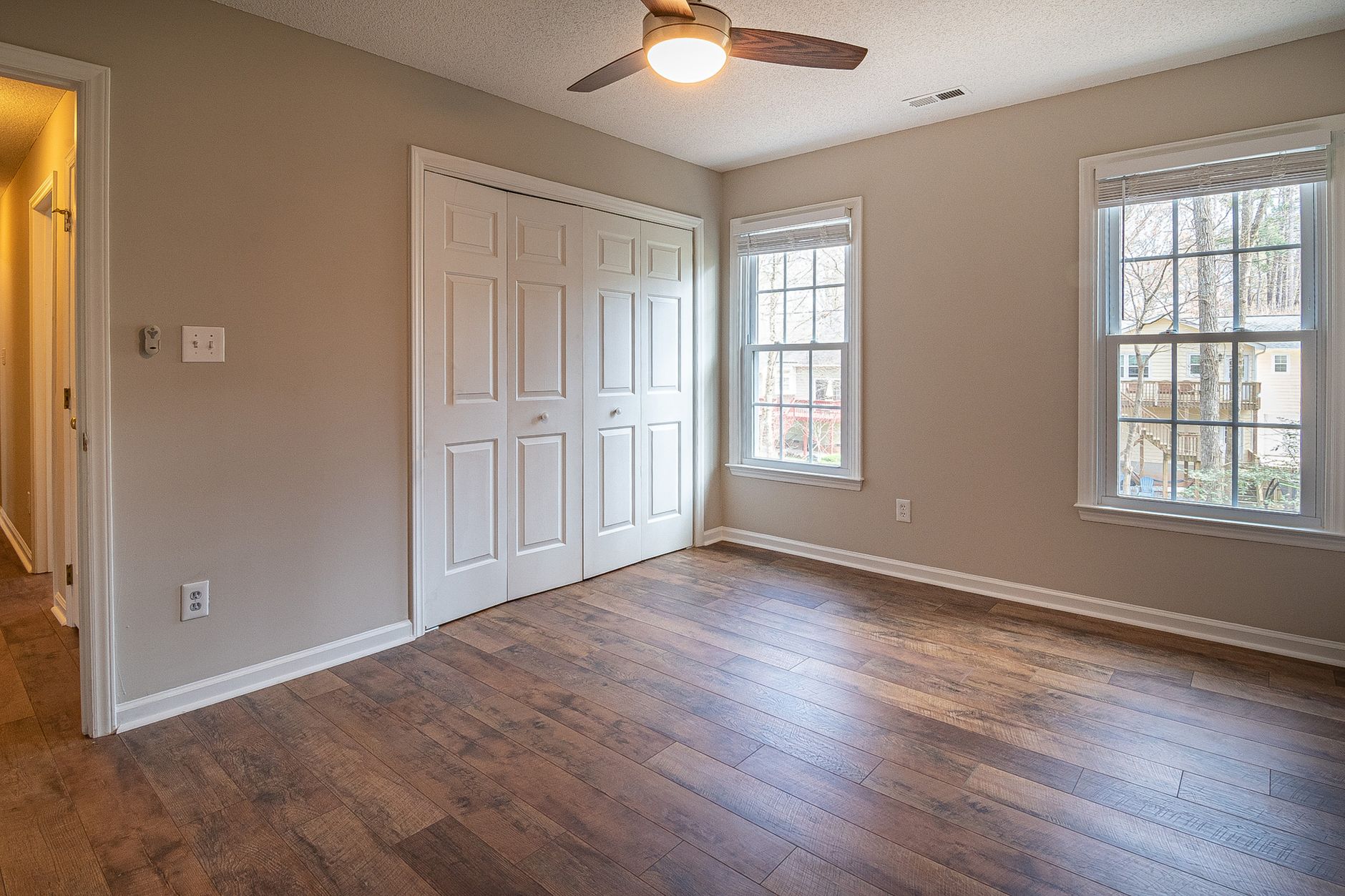
A hollow sound usually means the floor has lost contact with what it was glued or nailed to. On a slab, that almost always traces back to two things: how much moisture was still leaving the concrete when the floor went down, and how much the wood or engineered wood has shrunk since, especially through a dry Utah winter. Neither shows up at closing. Both show up later.
What is actually happening under the floor
Glue-down wood and engineered wood are bonded to the slab across their whole surface. When that bond is solid, walking across the floor produces almost no sound at all — the wood, the adhesive, and the concrete move together. A hollow, drum-like sound means the adhesive has let go in a patch. The board is still there, still level enough to walk on, but it is bridging a small void instead of sitting on solid contact.
Floating floors — most laminate and much of luxury vinyl plank — are a different case. They are never glued to the slab at all; the planks lock to each other and float over a pad. A faint hollow sound in a floating floor is normal and does not mean failure. A hollow sound that has gotten louder, or that is now paired with visible gaps at the seams, is the sign worth paying attention to.
Why does a builder-installed floor fail this way more often?
Production home schedules move on a framework, not on a slab’s chemistry. A new concrete slab keeps releasing water for months after it looks and feels dry, and the accepted way to know when it is actually ready is an in-situ relative humidity test — ASTM F2170, probes set at 40% of the slab’s depth, or 20% if the slab dries from two sides, after a minimum 24-hour equilibration. Most wood flooring and adhesive manufacturers set their acceptance limit around 75-80% RH. Thirty days per inch of slab thickness is a rule of thumb for rough planning, never a substitute for the test.
A framing-to-flooring schedule built around trade sequencing, not concrete curing, is exactly the condition under which a slab can still be releasing more moisture than the adhesive was rated for on installation day. The adhesive bonds well enough to pass a walk-through. It does not bond well enough to hold for years. What a new Utah slab needs before flooring goes down and what an ASTM F2170 probe actually measures cover the testing itself in more depth.
Why did it take two years to show up?
A marginal bond does not fail on day one. It fails when something stresses it, and the annual stress in Utah is winter. Furnace-heated indoor air in January can fall well under the 30-40% relative humidity that most flooring wants year-round. Wood and engineered wood give up moisture to that dry air and shrink slightly. Boards that were already holding on by a thin, moisture-compromised bond let go under that seasonal pull. The gap opens, and the hollow sound that was faint in year one becomes obvious by year two or three, usually worst along exterior walls and in rooms that get direct winter sun through a window.
This is also why the sound often reappears every winter and quiets down in summer. It is not the floor breaking down further each year — it is the same marginal area opening and closing with the season. That pattern is a useful clue when narrowing down whether the issue is adhesive coverage, sub-slab moisture, or just normal seasonal movement in a floating floor.
Does a hollow sound mean the floor needs to come out?
Not automatically. A small hollow area in a glue-down floor can sometimes be re-adhered through the board with injected adhesive, without pulling anything up. A widespread hollow sound across many rooms, or one paired with cupping, crowning, or visible separation at seams, points toward removal and replacement rather than a spot repair.
Removing an existing floor typically runs $1-$4 per square foot, and replacement cost depends heavily on what goes back down — hardwood installed runs $6-$21 per square foot, engineered and laminate options run lower, and luxury vinyl plank runs $2-$12. These are planning ranges only; the actual number for a specific room depends on square footage, subfloor condition, and the material chosen, and the flooring cost estimator is built to work through those variables for a specific project rather than a generic one.
What should get tested before anything is redone
Before a repair or a full tear-out gets scheduled, the slab moisture question is worth answering directly rather than guessing from the symptom. An RH test done to ASTM F2170 — three probes for the first 1,000 square feet, one more per additional 1,000, with at least one probe within three feet of every exterior wall — will show whether the slab is now within an acceptable range or whether it was never fully dry when the original floor went down.
If the fix involves opening up flooring installed before a certain date, checking with the local building or planning department about permitting is the reader’s next step, since permitting in Utah is enforced city by city and county by county, not by the state. Anyone hired to test or diagnose the floor can also be verified through the Utah Division of Professional Licensing’s contractor search; the state’s S220 Carpentry and Flooring classification covers this kind of wood floor diagnostic and repair work, though carpet and vinyl installation are specifically exempt from that licensing requirement.
Does the flooring material matter here?
It does. Solid hardwood over a slab is the most exposed to this failure mode because it moves the most with humidity and depends entirely on adhesive contact. Engineered wood is more dimensionally stable but not immune. Tile, at $9-$14 per square foot installed as another planning range, is mortar-bonded rather than adhesive-bonded to a wood-based substrate and does not show this hollow-sound pattern the same way, though a hollow tap under tile can still mean a thinset void. A basement slab has its own added complication of below-grade moisture on top of everything a main-floor slab deals with; choosing a floor for a Utah basement slab covers that case specifically. For a broader look at which materials handle a slab well and which do not, the flooring materials hub breaks down all eight by where each one is a poor fit. City-specific housing stock context is available at the Utah flooring by city hub, and overall installed cost ranges by material and location are gathered at the Utah flooring cost hub. General diagnostic and prep topics are collected in the installation and prep archive.
UTFloors is an independent Utah flooring resource. We do not sell or install flooring, we do not quote jobs, and nobody from this site will call you. Cost figures here are published planning ranges for Utah, not quotes — what you actually pay depends on your rooms, your subfloor and the material you choose, and the final price depends on your project. Photography is licensed stock used to illustrate materials and rooms; it is not work by anyone connected to this site. Building code and permit requirements are enforced locally in Utah, so confirm anything regulatory with your own municipality before you rely on it.
Any prices mentioned are indicative only. Tool prices move constantly and vary by market, by retailer, and by whether a kit includes batteries or a charger — check the current price yourself before deciding.
Featured image: Photo by Curtis Adams via Pexels.