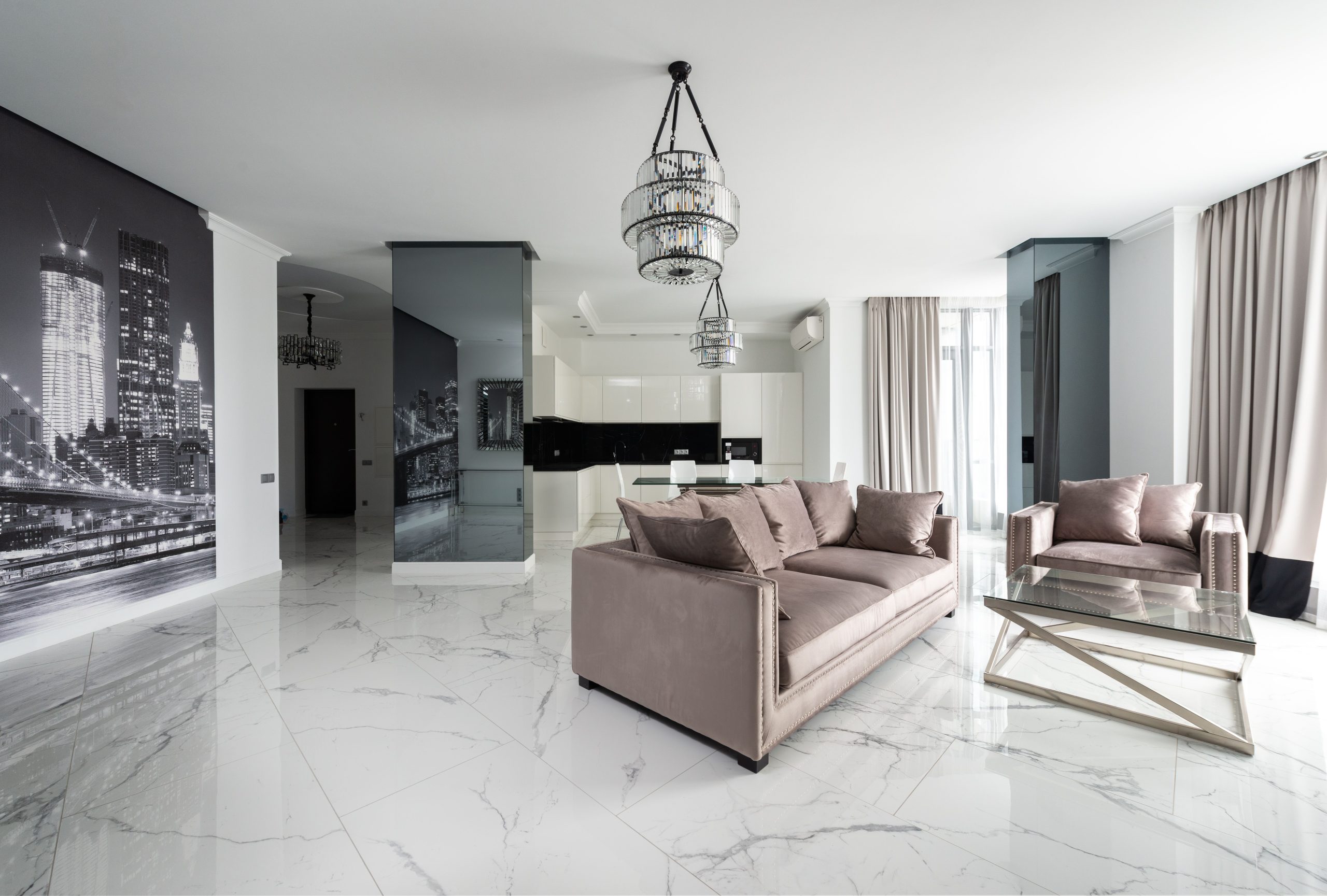
Tile and Porcelain Flooring in Utah: Costs, Slabs and Cracked Grout
Tile is the most durable floor you can put in a Utah house and the least forgiving of a substrate that moves. Nearly every cracked tile in this state is a structural story or a moisture story — rarely a tile story.
Two substrates, two different failures
Utah puts tile on two very different things, and they fail differently.
On a slab — main floors in newer construction, and every basement — the enemies are moisture and cracks that already exist. A slab that is still drying will push moisture up through the mortar bed; a slab with a shrinkage crack will telegraph that crack straight through the tile above it, usually within the first year.
On a wood-framed floor — upper storeys, and the older Salt Lake City and Ogden housing — the enemy is deflection. Tile does not bend. The industry measure is L/360 for ceramic and L/720 for natural stone: the floor must not deflect more than the joist span divided by that number under load. In older housing with long spans, that means the framing needs attention before the tile does.
The membrane that is worth its cost
- An uncoupling membrane — the dimpled mat sold under several brand names — lets the tile assembly move independently of what is under it. Over a slab it is the standard answer to an existing crack; over a wood floor it absorbs ordinary seasonal movement. It does not stiffen a bouncy floor and it does not substitute for fixing deflection.
- Cement backer board over a properly stiff wood subfloor is the traditional and still entirely valid approach.
- Directly over old vinyl or a floating floor — no. Tile needs a bonded, rigid, non-moving base.
Porcelain versus ceramic
Porcelain is fired denser and absorbs under 0.5% water, which makes it harder, heavier and more difficult to cut. Ceramic is softer, cheaper and easier to work with. Inside a conditioned Utah house both are adequate. Where porcelain earns its premium is wear — an entry, a kitchen, anywhere a chair is dragged — and anywhere the tile continues outside, where Utah’s freeze-thaw cycling is real and ceramic is not a candidate.
For a wet room the number that matters is the coefficient of friction. A polished porcelain that looks superb in a showroom is genuinely dangerous inside a front door in February.
Grout, and why it fails first
Cementitious grout is porous and stains; it is also cheap and easy to repair. Epoxy grout is effectively stain-proof, considerably more expensive, and unforgiving to install. For most residential floors a good cementitious grout, sealed, is the right trade.
What is not negotiable is a soft joint — flexible caulk rather than grout — where the tile meets a wall, a cabinet or another material, and over any control joint in the slab beneath. Grout run hard into a corner or straight across a slab joint cracks there first, every time.
What it costs
Installed tile in Utah generally runs $9 to $15 per square foot for a straightforward residential floor. Pattern work, large-format tile that needs a flatter substrate, and any structural or crack-isolation work underneath all move that figure upward — and the work underneath is the one that tends to surprise people.
An estimate, not a quote. These are planning ranges for Utah, not a quote. What you actually pay depends on your rooms, your subfloor and the material you choose.
Why did my tile floor crack in a straight line?
A crack running straight across several tiles is almost always the substrate moving underneath, not a defective tile. On a slab it is usually a shrinkage crack telegraphing through; on a wood floor it is usually a joist or a subfloor seam. Replacing the tiles without isolating that crack guarantees a repeat.
Is tile cold in a Utah house?
On a basement slab in January, yes — and it is the floor that feels best in a St. George July for the same reason. Electric mat heating under tile is inexpensive to add during the job and expensive afterwards, so it is a decision to make up front.
Does tile work need a Utah contractor license?
Yes — tile falls inside the S220 Carpentry and Flooring classification, unlike carpet and vinyl plank, which the rule expressly exempts. Worth asking about, alongside insurance and references.