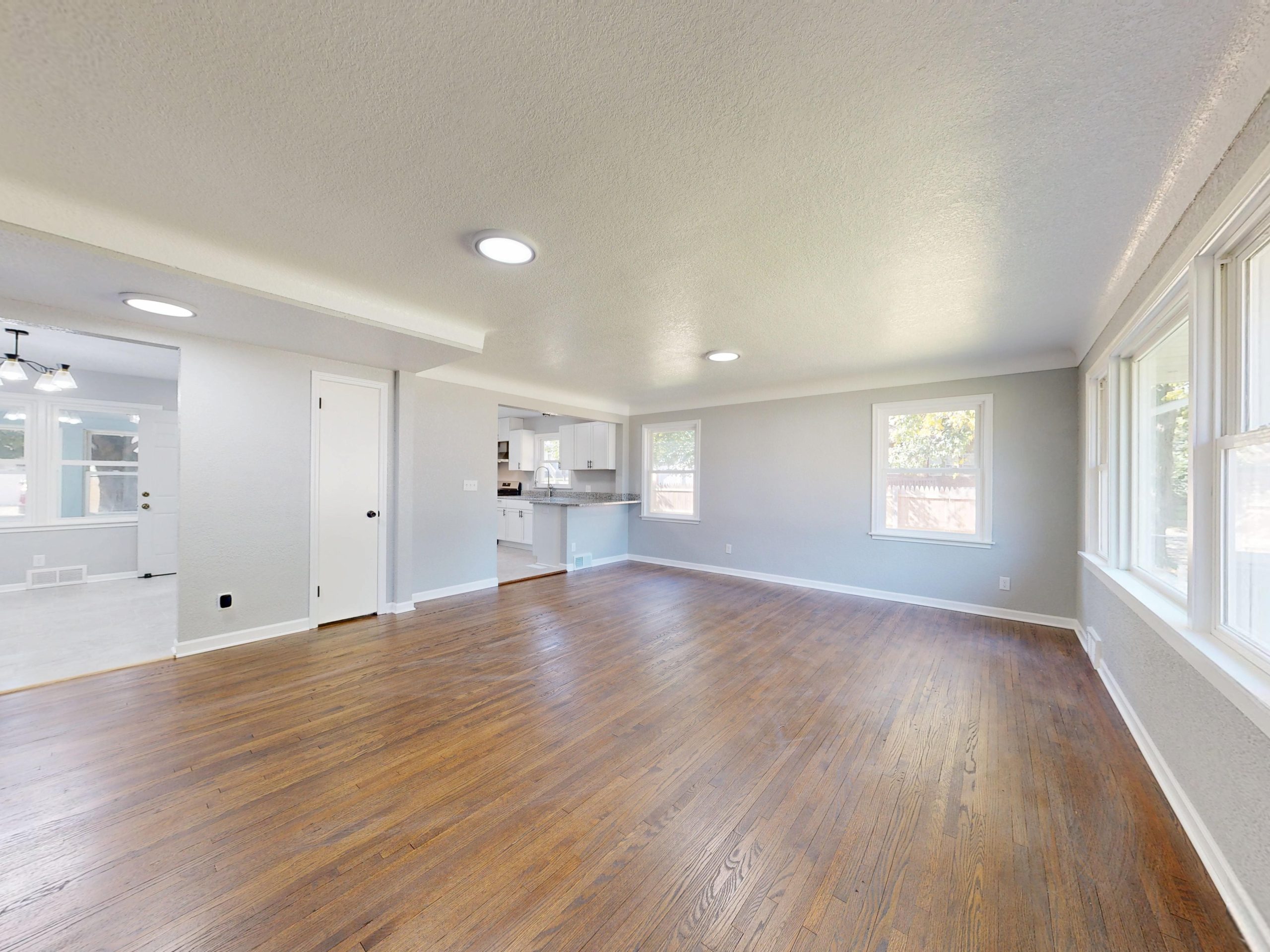
Hardwood Flooring Installation in Utah: The Slab and Winter Gaps
Hardwood is still the floor with the best resale return on this list. In Utah it has two specific ways of going wrong, and which one you get depends almost entirely on how old your house is.
If the house is new, the slab decides everything
Almost 39% of Utah homes were built in 2000 or later, and in Utah County it is over half. In a house that new, the concrete under your floor may still be releasing water. Concrete does not stop drying when the surface looks dry — it keeps giving up moisture from deep in the slab for months, and the only thing standing between that moisture and your floor is the covering you just paid for.
Over a wet slab, glued engineered wood debonds, seams peak, and organic growth starts underneath where nobody sees it until there is a smell. None of it shows on day one. That is what makes it expensive: by the time the floor tells you, the floor is the thing that has to come up.
The number to ask for
The rule of thumb is roughly thirty days of drying per inch of slab thickness in good conditions. Conditions are rarely good, and the calendar is not the test. The test is an in-situ relative humidity probe under ASTM F2170:
- Drilled to 40% of the slab depth — or 20% if the slab can dry from both sides. A surface reading tells you about the surface, which is the part that dries first and matters least.
- Left to equilibrate at least 24 hours before anyone reads it.
- Three probes for the first 1,000 square feet, plus one for each additional 1,000, with one within three feet of every exterior wall.
- Most wood flooring wants 75–80% RH or below. Sheet vinyl and LVT usually allow a little more. The manufacturer’s number is the one that governs the warranty.
Ask the installer what the probes read and where they were placed. An installer who can answer that has told you more than any certificate could. If the slab is not ready, the honest options are to wait, to use a moisture-mitigation coating, or to choose a floor that does not care — not to proceed and hope.
If the house is old, you may already own a hardwood floor
The other half of Utah is a completely different job. A third of Salt Lake City’s housing predates 1940 and 27.8% of Ogden’s does. In those neighborhoods, original oak under the carpet is a routine find rather than a lucky one, and refinishing it costs roughly a third of laying a new floor. Pull up a corner of carpet in a closet before you price anything else.
Then winter arrives and the problem inverts
Once the slab is dry, Utah stops being a moisture problem and becomes a dryness one. Indoor humidity through a Utah heating season runs very low. Wood gives up moisture to dry air and shrinks across the width of each board, and gaps open at the seams — usually in the first February, usually alarming, and usually normal.
Two things keep it in check. Acclimate the material in the room it is going into, at the humidity that room actually runs, rather than fitting it the week it arrives. And hold the house somewhere in the 30–40% range through the heating season. A floor that was dry when it went down and lives in a house that stays reasonable will move seasonally and close back up.
Solid or engineered
Engineered hardwood is a plywood or HDF core with a real wood wear layer, and its cross-laminated core moves less across a humidity swing. In a state that swings from a damp slab in spring to very dry air in January, that stability is a technical argument rather than a sales one — and it is the only wood that belongs on a slab at all.
Solid hardwood is still the better long-term floor above grade on a wood subfloor, in the older Salt Lake City and Ogden housing where that is what you have. It sands more times and it will outlive several generations of everything else on this list.
What it costs
Installed hardwood in Utah generally lands between $6 and $22 per square foot, materials and labor together. A mid-grade engineered oak floated over a prepared slab sits near the bottom; a wide-plank white oak nailed down, stained and finished on site sits near the top. Moisture mitigation over a slab that is not ready is a separate line and belongs in the budget before the flooring does.
An estimate, not a quote. These are planning ranges for Utah, not a quote. What you actually pay depends on your rooms, your subfloor and the material you choose.
Where hardwood is the wrong answer
- On a slab that has not been tested. Not “on a slab” — on an untested one. Test first; the answer may well be fine.
- Solid hardwood below grade. A finished basement is a slab, and solid wood does not belong on one at any moisture reading.
- Full bathrooms and laundry rooms. Standing water and wood are a bad pairing in any climate.
How long after a new house is built can I install hardwood?
Until the slab passes a moisture test, which is not a fixed number of weeks. The rule of thumb is about thirty days per inch of thickness in good drying conditions, but the answer that governs the warranty comes from an in-situ RH probe at 40% of slab depth. Most wood flooring wants 75–80% RH or below.
Why did gaps open between my boards in January?
Dry indoor air. Wood releases moisture into it and shrinks across the width of each board. It is seasonal and it usually closes back up in spring. Keeping the house in the 30–40% range through winter reduces it considerably; a floor that was never properly acclimated does it worst.
Can engineered hardwood go on a basement slab?
Yes, if the slab tests dry enough and the product is rated for below grade — that is exactly what engineered wood is for. Solid hardwood cannot. Either way the moisture test comes first.